Walk into any woodworking shop running a CNC router without a properly sized dust collection system, and you can spot the problem before you even see the machine — a fine layer of dust on every surface, a hazy spindle area, and an operator squinting through a cloud of MDF or plywood particulate. Dust collection is one of the most under-specified parts of a CNC workshop setup, and it’s also one of the most expensive mistakes to fix after the fact, because ducting is bolted to walls and ceilings, not bolted to the machine.
This guide breaks down exactly how to size a dust collection system for an industrial CNC router — from calculating your real CFM (cubic feet per minute) requirement, to laying out ducting that doesn’t rob your system of the airflow you paid for.
Why Dust Collection Is a Machine Spec, Not an Afterthought
A CNC router’s cutting performance is directly tied to how well chips and dust are cleared from the cut path. When dust collection is undersized:
- Fine MDF and plywood dust re-deposits on the cutting surface, which increases friction, heat, and the risk of the material scorching — a problem we’ve covered in detail when discussing spindle power for MDF wall panel routing.
- Vacuum table hold-down suffers, because dust accumulating in the table’s air channels reduces the suction that keeps sheets from shifting mid-cut.
- Tool life drops, since re-cut dust and chips act like sandpaper against the cutting edge.
- Airborne fine particulate (PM2.5-range MDF and MDF-resin dust) becomes a genuine respiratory hazard for operators, and in enclosed shops, a combustible dust risk.
In other words, dust collection isn’t a “nice to have” bolted onto a CNC router after installation — it’s a system that should be sized alongside the machine itself, the same way you’d size a spindle or a vacuum table.
Step 1: Calculate Your Real CFM Requirement
CFM (cubic feet per minute) tells you how much air volume your dust collector needs to move to keep up with your CNC router. Manufacturers typically publish a recommended CFM per dust port, but the number that actually matters is your total system CFM, which depends on:
- The number and diameter of dust collection ports on the machine
- Hose/duct diameter and length
- Number of fittings, bends, and blast gates in the line
- Whether you’re running one machine or multiple machines off a shared collector
Typical CFM Requirements by Router Size
| Router Type | Cutting Area | Recommended CFM |
|---|---|---|
| Hobby/entry CNC router | Up to 4×4 ft | 400–600 CFM |
| Mid-size industrial router (single spindle) | 4×8 ft | 800–1,200 CFM |
| Heavy-duty industrial router (single spindle, deep cuts) | 4×8 ft to 5×10 ft | 1,200–1,800 CFM |
| Multi-spindle / nesting CNC router | 5×10 ft+ | 1,800–2,500+ CFM |
These figures assume a single 4-inch dust port at the spindle hood. If your machine runs dual dust ports (common on larger nesting routers), or if you’re collecting from both the router and a secondary process like edge banding, CFM requirements stack — don’t split one collector’s rated CFM across two machines and assume each still gets full performance.
The Formula Behind the Table
For a single 4-inch round duct, the airflow needed to maintain a minimum transport velocity of 4,000 feet per minute (the industry standard for keeping wood and MDF dust suspended in the airstream, rather than settling inside the duct) works out to roughly:
CFM = Duct cross-sectional area (sq. ft) × Transport velocity (FPM)
For a 4-inch duct: 0.0873 sq. ft × 4,000 FPM ≈ 349 CFM minimum just to keep that single duct clear. Most CNC router manufacturers spec above this baseline because a real dust hood is pulling from an open cutting area, not a sealed pipe — which is why 800–1,200 CFM is the realistic working range for a mid-size industrial machine, not the bare duct minimum.
Step 2: Understand Static Pressure — the Number That Actually Kills Performance
CFM ratings on dust collector spec sheets are almost always measured at zero static pressure — meaning open air, no ducting, no filter, no bends. The moment you connect real ducting, filters, and fittings, your actual CFM drops, sometimes by 30–50%.
Static pressure loss comes from:
- Duct length — every additional foot of ducting adds resistance
- Bends and elbows — a 90° elbow can cost as much static pressure as 8–10 feet of straight duct
- Reducers — stepping down from a 6-inch main to a 4-inch machine port
- Filter loading — a dust collector’s filter bags or cartridges lose efficiency as they load with fine dust between cleanings
- Blast gates left partially open on unused branches
Practical takeaway: when sizing a collector, don’t buy to the machine’s rated CFM — buy to the machine’s rated CFM after accounting for your actual duct run, then add a margin. A collector rated for exactly 1,200 CFM at zero static pressure might only deliver 800–900 CFM once it’s ducted to your machine 25 feet away with two elbows in the line.
Step 3: Ducting Layout Rules That Actually Matter
Size the Main Trunk Line Correctly
The main duct line should never be smaller than the combined cross-sectional area of the branch ducts it feeds. A common mistake is running a 6-inch main line into multiple 4-inch branches without upsizing — this starves whichever machine is running furthest from the collector.
Keep Runs Short and Straight
Every foot of duct and every bend adds resistance. Where possible:
- Position the dust collector as close to the CNC router as the shop layout allows
- Use long-sweep elbows (gradual bend radius) instead of sharp 90° elbows — they cost far less static pressure
- Avoid unnecessary Y-branches; a straight run with a properly sized blast gate performs better than a tangle of shortcuts
Metal Ducting Over Flexible Hose for Main Runs
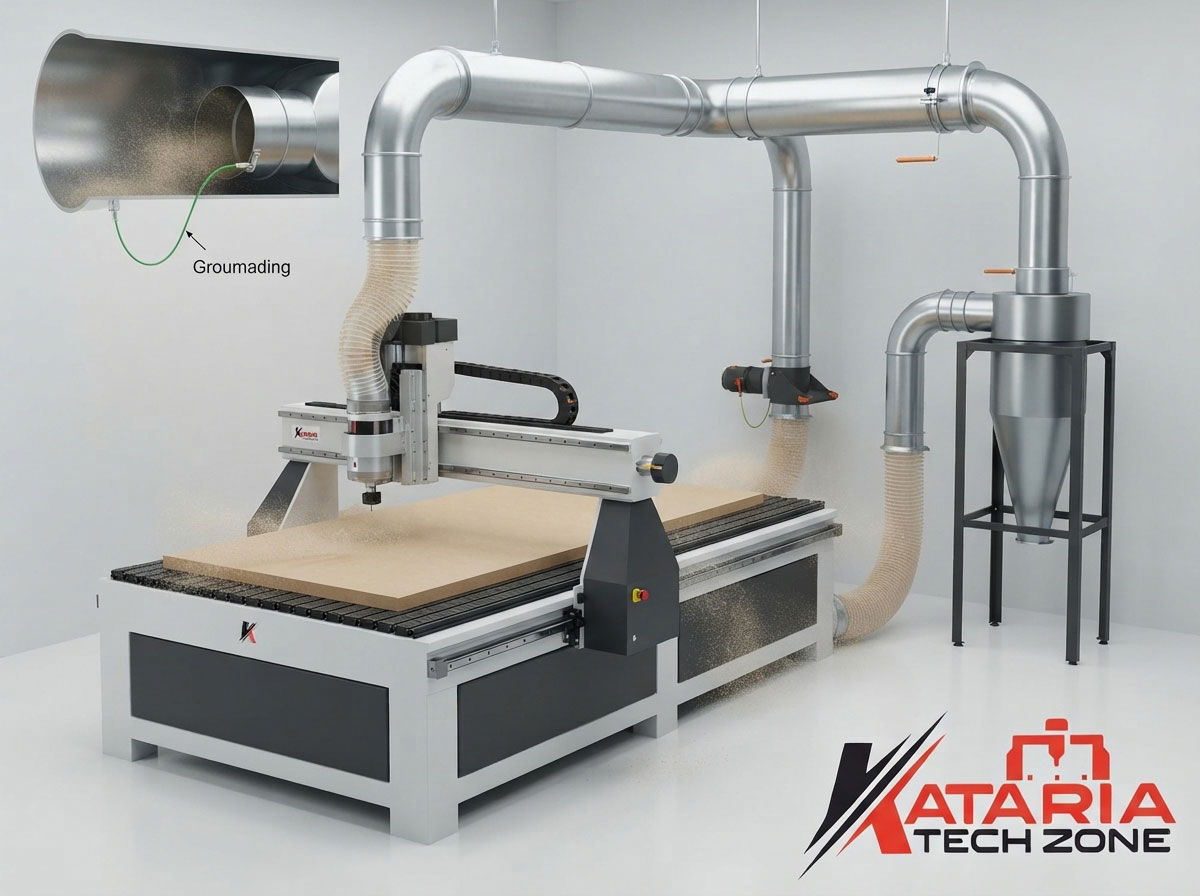
Flexible corrugated hose is fine for the last few feet connecting to the machine’s dust port, but using it for long main runs is one of the most common ducting mistakes in small-to-mid shops. The corrugated interior creates turbulence and drag that can cut effective airflow by 20% or more compared to smooth-wall metal or PVC duct of the same diameter.
Ground Your Ducting
MDF, plywood, and plastic dust moving at high velocity through plastic or PVC ducting generates static electricity. Without grounding wire run through or alongside the ductwork, that static charge can build to the point of a visible spark — a real ignition risk in a space full of fine, combustible dust. Bonding and grounding the entire duct run, including flexible sections, is a basic safety requirement, not an optional upgrade.
Blast Gates for Multi-Machine Shops
If one dust collector serves more than one machine — a CNC router, a panel saw, an edge bander — install blast gates at each branch and keep all gates closed except the one for the machine currently running. An open, unused branch bleeds airflow away from the machine that actually needs it, which is one of the most common causes of “my dust collector should be big enough but performance is still bad.”
Step 4: Filtration — CFM Means Nothing Without It
A dust collector that moves plenty of air but filters poorly just relocates the dust problem from the cutting area to the shop floor and the air your operators breathe.
- Cyclone pre-separators pull the majority of heavier chips and dust out of the airstream before it reaches the filter, dramatically extending filter life and maintaining better CFM over time, since the main filter isn’t loading up as fast.
- Cartridge filters rated for fine MDF dust (sub-5-micron capture) are worth the extra cost over basic bag filters, given how fine MDF and resin-bound composite dust actually is.
- Filter cleaning systems (pulse-jet or manual shaker) matter more than people expect — a loaded filter that isn’t cleaned regularly is functionally reducing your system’s real CFM, even though the collector’s rated capacity hasn’t changed.
Step 5: Match Dust Collection to the Material You’re Actually Cutting
Not all CNC cutting generates the same dust load. Workshops producing 3D-textured MDF wall panels and decorative molding generate significantly more fine dust per cutting hour than a shop doing simple sign-cutting or joinery work, because deep 3D relief carving with ball-nose bits removes far more material volume per pass. If your production mix leans heavily toward decorative panel or high-material-removal work, size your system toward the upper end of the CFM range for your router class, not the baseline figure.
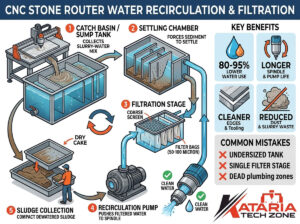
Shops running a CNC stone router alongside a wood/MDF router need a completely separate dust and slurry handling approach — stone dust (especially engineered quartz) carries silica exposure risk that standard wood dust collectors and filters aren’t rated for. Never route stone dust and wood dust through the same collection system.
Common Mistakes That Undersize a “Correctly Sized” System
- Sizing to the machine’s rated port CFM without accounting for duct length and static pressure loss — leading to a collector that’s technically rated high enough but performs 30% below spec once installed.
- Running multiple machines off one collector without blast gates, splitting airflow across open branches instead of directing it where it’s needed.
- Using flexible hose for long main runs instead of smooth-wall metal or PVC ducting.
- Skipping duct grounding, creating a static discharge and combustible dust risk that’s invisible until it isn’t.
- Ignoring filter maintenance schedules, so real-world CFM degrades steadily even though the collector’s nameplate rating hasn’t changed.
- Treating dust collection as a one-time purchase instead of a system that needs to scale if a second machine, a nesting router, or higher-volume decorative panel work gets added later.
Sizing for Growth, Not Just Today’s Machine
If your shop is likely to add a second CNC router, a panel saw, or an edge banding line in the next few years, it’s worth sizing the main duct trunk and collector capacity with that expansion in mind now. Retrofitting a duct system after walls, ceilings, and floor slabs are finished is dramatically more expensive than running slightly oversized trunk ducting during the initial install.
Final Checklist Before You Order a Dust Collector
- [ ] Calculated CFM based on your router’s actual port size and cutting area, not just the machine’s minimum spec
- [ ] Accounted for static pressure loss from duct length, bends, and filter loading
- [ ] Sized the main trunk line to match combined branch duct cross-sectional area
- [ ] Chosen smooth-wall metal/PVC duct for main runs, flexible hose only for short machine connections
- [ ] Installed grounding/bonding wire through the entire duct run
- [ ] Added blast gates if more than one machine shares the collector
- [ ] Selected filtration rated for fine MDF/composite dust, with a cyclone pre-separator if cutting volume is high
- [ ] Planned trunk line capacity for future machine additions, not just the current setup
Talk to Kataria Tech Zone About Your Dust Collection Setup
Every CNC router we manufacture is built with dust port specifications suited to industrial production volumes, and our team can help you size the right collector and ducting layout for your specific shop — whether you’re running a single mid-size router or scaling up to a multi-machine production floor. If you’re setting up a new shop or upgrading an existing one, browse our full range of CNC routers and woodworking machinery on our product shop, or read more on our blog about getting the most out of your CNC setup — including our beginner’s guide to CNC routers for woodworking and our breakdown of CNC routers vs. traditional woodworking tools.